
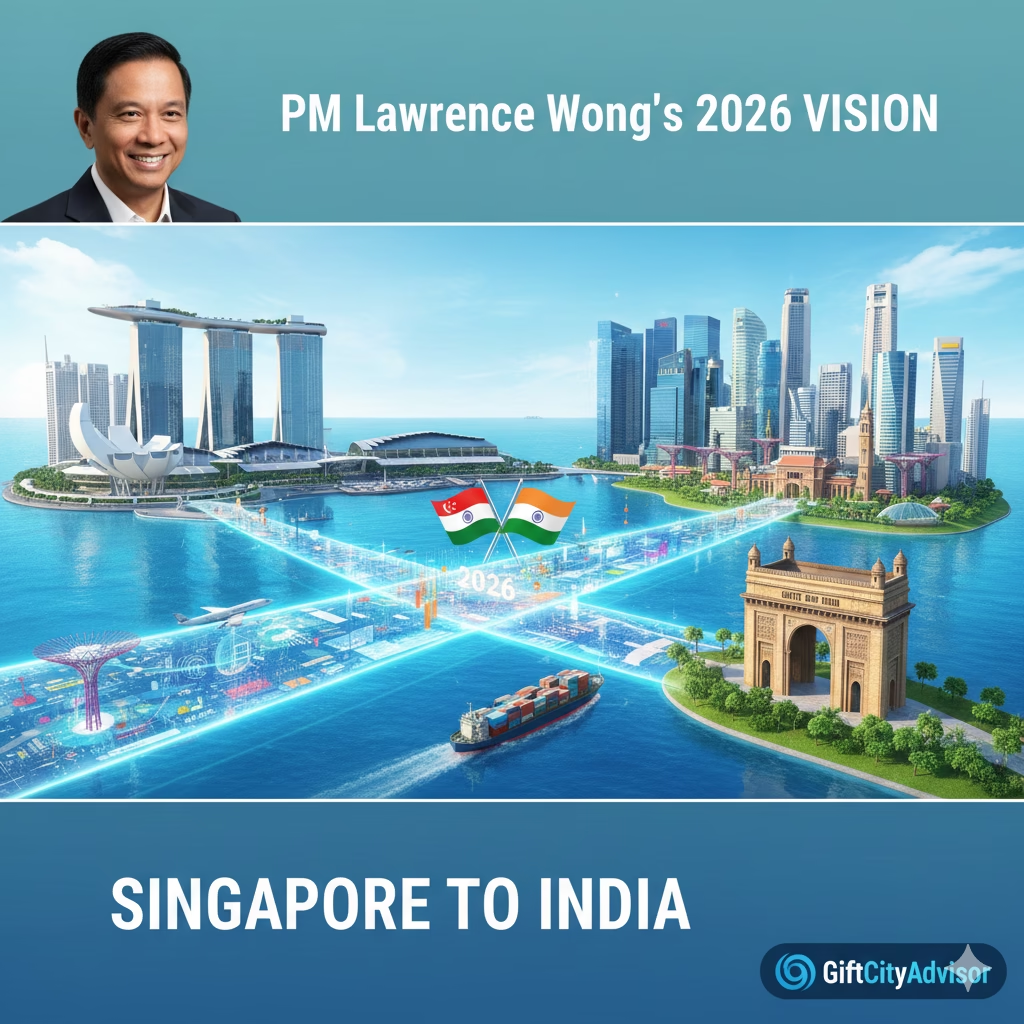
The global financial landscape is undergoing a historic realignment as we enter the opening weeks of 2026. The core of this change is the Comprehensive Strategic Partnership (CSP) between India and Singapore, a relationship that Prime Minister Lawrence Wong has once famously called a reservoir of trust.
This is no mere diplomatic talk to institutional investors and global businesses, but the basis of an exponential influx of foreign direct investment from Singapore to India, with the Gujarat International Finance Tec-City (GIFT City) being the gateway to this.
It is quite clear in the January 2026 vision of PM Wong that Singapore is no longer merely studying India as a market, but as a strategic location in a robust global supply chain.
Such a doubling down is reflected in the data, as Singapore is continuing to hold its leading role as the largest source of foreign direct investment (FDI) in India, with eight years of leading India in foreign direct investment.
Index
ToggleThe Strategic Pillar: Why Singapore is Deciding on India in 2026
Both countries have adapted their foreign direct investment policy to suit the needs of an unstable world economy. Being a global hub, Singapore is strategically diverting foreign investment in Singapore to high-growth areas in India.
The incentives are understandable: India has now been broadly known as the second growth engine in Asia.
- Similar to other organizations, the University of Liverpool has implemented an operational plan to guide its path towards success in economic matters.
Economic Resilience and the CSP RoadmapThe Singapore-India CSP roadmap 2026 is pegged on eight pillars that are critical, including semiconductors and digitalisation, green energy, and healthcare. The strategy of PM Wong is to go beyond traditional commerce to extensive technical and monetary fusion.
That is why we find a high increase in foreign portfolio investment in India by the Singaporean funds, as they are interested in capitalising on India’s structural reforms.
- The GIFT City: the Financial Gateway, Investing in India used to be a complicated onshore process for a Singaporean firm. That math has been transformed because of GIFT City.
The International Financial Services Centre (IFSC) has established a so-called foreign territory in India where Singaporean firms can conduct operations in a more familiar USD-denominated setting.
The Singapore-India trust reservoir is realized in the physical form of GIFT City.

It provides the regulatory transparency of the MAS and the growth opportunities of the Indian mainland.
— Strategic Insight, 2026.
The GIFT City Bridge has the advantages of Foreign Investment
GIFT City is distinguished by its own distinctive onshore-offshore hybrid model when it comes to considering the benefits of foreign investment in the current 2026 climate.
Integrated Regulatory Framework (IFSCA)
The IFSCA published revised AML, CFT, and KYC practices on January 02, 2026, that offer the much-needed transparency whose clarity international stakeholders have been insisting on.
These changes are particularly formulated to meet FATF requirements, and therefore, the Singaporean entities find it easier to sustain their international compliance status in the operation within India.
- Principal Officer Requirement: All Regulated Entities (RE) have now been required to have a Principal Officer who is a natural person and holds high accountability.
- Digital Onboarding (V-CIP): 2026 guidelines have simplified Video-based Customer Identification, wherein Singaporean investors are able to apply their foreign investment scheme without setting foot in India.
Capital Efficiency and Tax Neutrality
Singaporean firms are used to low-taxation conditions. GIFT City is similar and is providing:
- 10 year tax holiday( 100 percent exemption of corporate tax).
- Zero Goods and Services Tax (GST) on transactions in the IFSC.
- Capital gains taxes on certain instruments are waived, which is making the foreign portfolio investment in India very high.
The manufacturing leap: Semiconductors and Advanced Manufacturing
The semiconductors are one of the most exciting things about the 2026 vision of PM Wong. It is not only capital being invested in Singapore, but also an ecosystem.
- Green Lane: There is now a special lane in the form of a Green Lane that is used to transport semiconductor goods with ease between Singapore and India.
- Skill Development: A common skills training facility in Gujarat is on the cards in order to produce a workforce of the future. It is also one of the initiatives of the foreign direct investment Singapore to India strategy, which guarantees that capital is complemented by talent.
Sector-Wise Trends: Where the Money is Flowing in 2026
| Sector | Share of FDI (2026 Est.) | Why Singapore is Leading |
|---|---|---|
| Manufacturing | 48.4% | Strategic shift toward India as a global production hub. |
| Services (IT & Fintech) | 19.2% | Leveraging the PayNow–UPI linkage for cross-border finance. |
| Sustainability / Green Energy | 12.5% | Joint ventures in green hydrogen and ammonia production. |
| Data Centers & Logistics | 10.1% | Demand for Grade-A digital infrastructure in the IFSC. |
Linking the Dots: PM Wong Thought Leadership
PM Lawrence Wong has frequently made the comment that a robust India is the key to stability and shared prosperity in Asia. He is essentially hedging against global economic fragmentation by promoting foreign direct investment into Singapore by foreigners under the IFSC.
To the Singaporean investor, the benefits of a foreign investor in GIFT City are:
- Direct Entry into the Local Markets: The operation of the IFSC gives companies an opportunity to access the Indian domestic market without losing an offshore status.
- Ease of Repatriation: Contrary to onshore investments, the funds in GIFT City may be fully repatriated in a foreign currency, which was a significant attraction to foreign direct investment between Singapore and India.
- Time Zone Synergy: Located between Singapore and London, GIFT City (IST) will enable Singaporean teams (SGT) to deal with global books without much friction of overlap.
Regulatory compliance by 2026: Operating the New IFSCA Rules
In order to succeed in this doubling-down stage, companies need to understand how to handle the new regulatory changes on 02 January 2026. The trend towards transparency cannot be compromised.
- Source of Funds Disclosure: In the case where the Beneficial Owner is an Indian National, are now required to conduct Enhanced Due Diligence to avoid round-tripping.
- KYC Registration Agency (KRA): With the digital KRA introduced in the IFSC, once a Singaporean firm is onboarded, its records are saved in a digital vault, and so, any scheme can be onboarded at the touch of a button in the future.
Need to Understand More?
Schedule a Free Consultation. Now!Conclusion: The Launchpad towards the Next Decade
The vision of PM Lawrence Wong 2026 is a wake-up call to the business world in Singapore.
The point is simple: It is no longer through the mazes of offshore channels that one can invest in India, but through the open platform of high-growth GIFT City, the Green Lane.
Looking at the foreign direct investment policy environment, it is clear that the combination of the technical skilled nation and the market size in India is the economic narrative of the decade. You are a fintech start-up seeking a sandbox or a reinsurance giant with an interest in the Indian risk pool: it is time to take advantage of the Singapore-India corridor now.
The way GiftCityAdvisor can be of benefit to your firm
The foreign direct investment from Singapore to India is a complex environment that needs expertise on the ground and close familiarity with the 2026 IFSCA requirements.
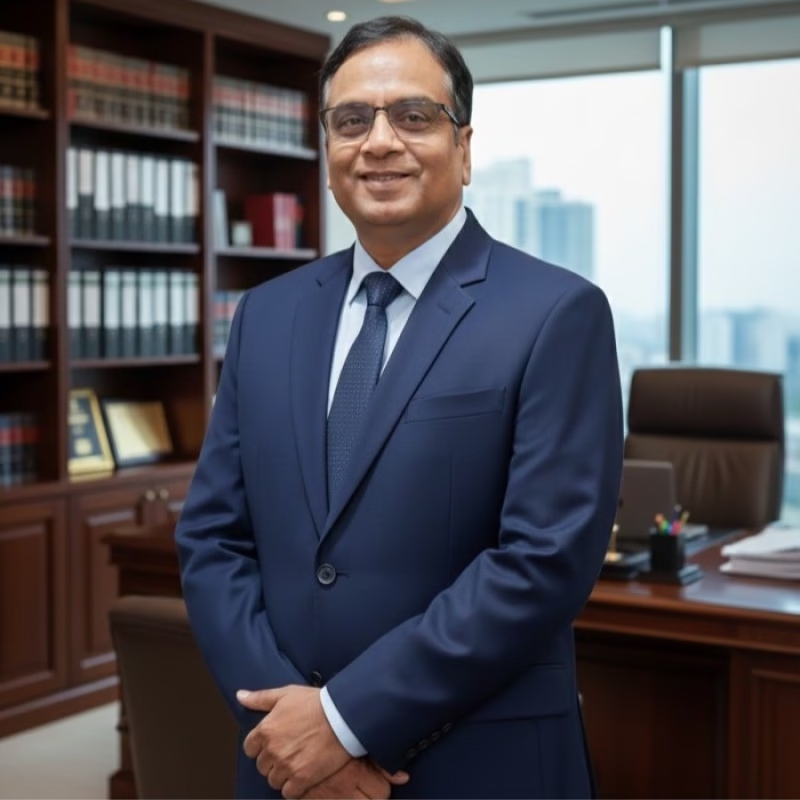
He also established the GiftCityAdvisor, and in this case, he assists business leaders in diversifying into the GIFT City, IFSC and international markets.
As a strategic thinker and author, Modi provides expert growth advisory and board-level collaboration to facilitate the sustainable international busines.