Index
ToggleWorld Economy
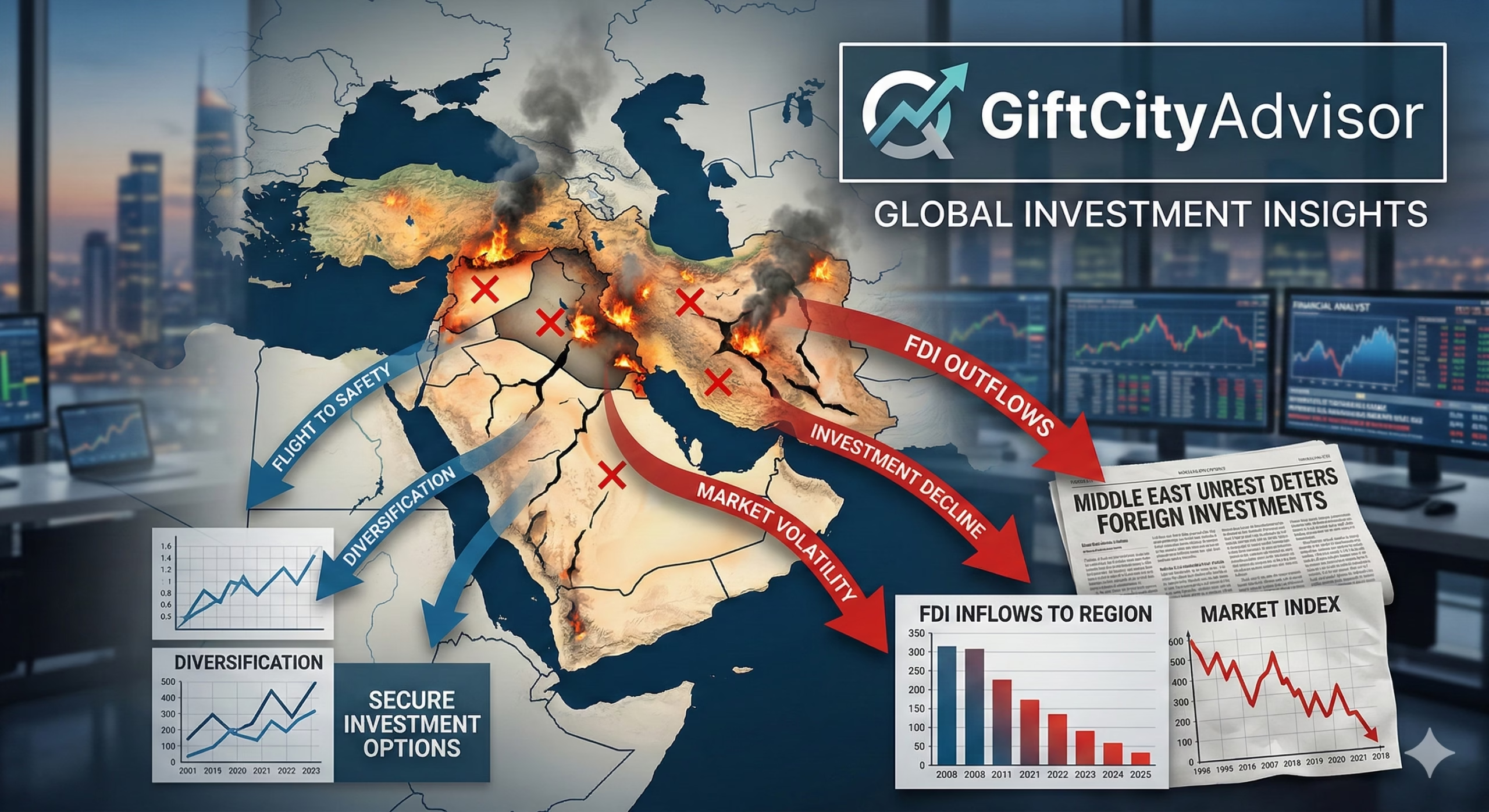
The world economy has been rewired essentially during the last week. After the intensification of the military conflict in the Middle East on February 28, 2026, the international economic community is no longer in the condition of moderate optimism but in the condition of a high-vigilance Risk-Off.
With military operations affecting strategic infrastructure and the imminent risk of an all-out war between the US and Iran, the initial response in the financial markets has been prompt and harsh, and has a structural implication.
To international investors, whether it is the high-rises of New York or the sovereign wealth-funds of Dubai, or the industrialisation-centred city in India, the Panic-to-Pricing dance is well underway.
The issue of the impact of this war on foreign direct investment (FDI) and capital markets is no longer of academic concern, but of institutional survival.
The Monday Morning Shock: Tehran to Mumbai Ripple Effect
The direct consequence was seen on March 2, 2026, when the Sensex crash erased almost 5 lakh crore investor wealth in a few minutes of the stock market opening.
The Indian markets plummeted by 3.4%, and the Dow Jones did the same as well as the DFM (Dubai Financial Market) thus indicating that the global markets were fleeing to safety. When the kinetic warfare becomes geopolitical tension, capital becomes a coward.
It avoids the risks emerging and runs to the areas of safety.
The gold has been on a run up to the target of 2,500/oz and the US Dollar has been on a strong ground, and the Rupee is drifting into a 91.5 psychological set point. The first wall, which is not visible to the international investors during times of war, is the currency volatility.
To the managers of cross-border capital, the local currencies most of the time tend to depreciate, more than the actual decline in the stock market, since it depreciates the value of the repatriated profits in real-time.
The Energy Cliff: Oil as an Economic Weapon of Attrition
Energy is, of course, the most direct connection between the Middle East war and the stability of investments in the world. Economic calculations of the energy-importing countries have been turned into a one-night affair with Brent Crude rising above the 80 per barrel mark.
India, which is already importing almost 88 percent of its oil needs, is experiencing a growing fiscal deficit and the imminent threat of cost-push inflation.
Nevertheless, the danger is not only the price itself, but it is the physical transit. The Strait of Hormuz, which serves almost 20 percent of the global oil demand and 50 percent of India’s LNG imports, is now the most examined water on Earth.
Any failure in this not only increases prices; it also stops supply chains. In the case of manufacturing-led FDI, it is a devastating risk. Investors in the Tech, Auto, and Chemical industries are now redefining the security of their supply chains, abandoning the vision of Efficiency-First to the approach of Resilience-First.
The realignment of FDI: Friend-Shoring to Neutral-Shoring
Federal Reserve and the Treasury in the USA are also keeping a close eye on the outward FDI. American pension funds and institutional investors are becoming more concerned about being exposed to Active Conflict Zones.
A tremendous strategic change that is being experienced is the diversion of capital out of the Middle East and other high-risk corridors into Stable Corridors.
Here, the idea of Friend-Shoring becomes Neutral-Shoring. Global capital is searching in 2026 for jurisdictions that are both physically out of the conflict but digitally and legally connected with global standards. The place of India, though located near the energy crisis, is a safe haven of capital; however, the capital must be placed in the form of structures that provide immunity against operational risks.
The change is also being experienced in the UAE, particularly in Dubai and Abu Dhabi. Although the Gulf is continuing to be a source of wealth, the sovereign wealth funds there are diversifying their portfolios with a new focus on the US-India corridor.
This is aimed at shifting assets between a Hot Zone and a Stable Zone whilst remaining globally liquid and mobile.
Check it out!
Learn more about International Financial Service Centre (IFSC) Consulting and how GIFT City structures can unlock global investment efficiency.
IFSCA-C →The Volatility of the Market and the Implementation of Regulations
Market integrity is the most important issue for regulators in times of panic related to the war. The SEBI chief has already indicated seriousness on insider trading in India, and it has become the responsibility of banks and consulting firms to treat price-sensitive information with the highest form of precautions.
This translates to the international investor that the only mechanism that can protect them against regulatory examination when a market crash strikes is transparency and compliance.
The new position of investors is the search for the so-called Financial Fortress, a legal and banking framework capable of withstanding a 12-month battle without going off global liquidity. This requires a shift to jurisdictions that provide:
- USD-Denominated Banking: To protect against the fluctuation of the Rupee or Dirham.
- Unified License: To enable rapid strategic shifts between fund management, banking, and trade finance.
- Fiscal Stability: i.e., tax holiday- 20 years long; this will be a long-term fiscal umbrella in case of the short-term military conflicts.
The Strategicness of Specialized Financial Hubs
The world tries its eye on the military map, but the sophisticated investors are trying on the financial map. There has never been a more appropriate international financial services centre model.
In case the Strait of Hormuz is threatened, a business entity that is under the supervision of a global body such as the IFSCA is an added protection level that is unmatched by other domestic units.
It could be an Indian MSME seeking capital in the USA via a Fund Management Entity (FME) or a Techfin automating trade finance to UK-India exporters; the goal is the same: to develop a business that is resistant to war.
This incorporates a professional manner of setting up entities and Banking. When the world is in a Risk-Off state, which will be the case in 2026, the last thing you want is to have your capital walled off by domestic banks.
You require the “Master Key” – a single registration enabling free movement of capital, free repatriation, and a constant, stable regulatory environment that does not shift each time a missile flies.
The Conclusion: The New Economic Baseline
The human tragedy of the Middle East war of 2026 is that it is a giant human stress test, but economically, it is a giant financial system stress test. Capital is a coward; however, it is also very clever. It will never take the road of least resistance and utmost security.
Since the Rupee is depreciating to 91.5 and oil prices are tightening margins, the victors of 2026 will be those who constructed their own “Financial Fortresses in 2012.
It is they who left mere Entity Setup behind to strategic Structural Autonomy. It is they who consulted an experienced GiftCityAdvisor or an International Financial Services Centre Consultant in order to future-proof their vision.
The cycle of the Panic-to-Pricing will ultimately level off, yet the structural harm to the ancient trade routes will be there. The stable, the compliant, and the neutral are the future of FDI.
Need to Understand More?
Schedule a Free Consultation. Now!Iran Conflict Market Impact
This analysis gives a close examination of the direct effects of military strikes in Iran on Sensex and the world energy security, as the foundation of the present day market strategies.